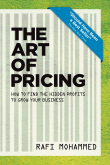
Pricing for Profits and Growth:
It's as simple as:
- 2 concepts
- 3 strategies
New Pricing Book:
March 16, 2010


Segment Based Pricing: Activate Dormant Customers with New Pricing Strategies

To attract new customers, some vacation homebuilders offer interval ownership timeshares which typically divide a condominium’s usage into fifty-two week segments. Customers purchase ownership for a week or two, good for the life of the condominium. This new pricing strategy has made the American dream of owning a vacation house a reality for many new customers, resulting in growth for the resort home-building industry. 

Ten Segment-Based Pricing Tactics.

Interval Ownership: Can you attract new customers by subdividing your product into smaller increments? For example, interval ownership has been the catalyst to growth in the private jet industry.

Bundling: Can bundling be used to grow your customer base by promoting convenience or inducing customers to buy products that they would not otherwise purchase? For example, many land line phone companies offer discounted bundles that include options that customers would not normally purchase (e.g., three-way calling, speed dialing).

Leasing: Can the “trading up to a better product for the same monthly payment” benefit, convenience, and financing attributes of leasing draw new customers to your product? For example, leasing is a key selling strategy for automobile companies. 

Prepaid: Can the features of prepaid pricing (e.g., impose discipline, easier to purchase, provide flexibility, serve the credit challenged) attract new customers to your product? For example, many wireless companies are focusing on selling “prepaid” cell phone plans as an avenue to growth.

Rental: Can you use rentals to serve new customers who want to use your product for a short period of time? For example, billionaire Warren Buffett owns Cort Furniture – a company that focuses on renting furniture to homes, businesses, and trade shows.

Two-Part Pricing: Can two-part pricing be used to attract new customers by stimulating purchases and serving those with different valuations? For example, Costco uses a two part pricing strategy. After paying a membership fee ranging from $50 - $100, members can buy products that are generally priced 15% below rival retailers’ prices.

Hurdles: Can hurdles draw in new clients who use your service (and value it) differently than your current customers do? For example, in addition to offering hourly rates, downtown parking garages target commuters with discounted rates to drivers that are “in by 9, out by 6.”

Payment Plans: Can payment plans that better match customers’ cash flows draw in new clients? For example, the Home Shopping Network (HSN) phrases its prices as $1,648 or a flex-payment option of making 5 monthly payments of $329.60. HSN is not charging interest for its monthly payment plan. Instead, the flex-payment plan is being used to attract customers who would not otherwise purchase from HSN.

Customized: Can you use customized pricing to attract new customers? For example, Progressive Auto Insurance has become the third largest auto insurer in the U.S. in great part because it offers customized rates to its customers.

All-You-Can-Eat: Can the convenience and peace of mind provided by all-you-can-eat pricing attract new customers? For example, one benefit of Netflix is the ability to watch as many movies as you wish for one fixed monthly price.

[Return to Top]
<<  Strategy 2: Versioning 
Customers may be interested in your product but resist purchasing simply because your current pricing strategy does not work for them. Offering new pricing strategies can activate these dormant customers.
Copyright © 2007-2010 Culture of Profit, LLC. Terms of Use | Privacy Policy | Contact Us